
Value Aligned Advisors Amplify your Cause

Enacting positive change is a team sport. Who do you want on that team? When your suppliers, mentors, and professional advisors share your value set, day to day business or organizational activities become less of a battle and more of a creative endeavour. Here are 4 reasons why shared value alignment amplifies your impact.

Trust

The basis for successful relationships is trust. Beginning with a mutual agreement on values such as honesty, transparency, or equity, allows your business or organization to focus on achieving, rather than apologizing for or rationalizing its existence and operating culture.

Collaboration

True collaboration occurs when the process embodies the goal. Team mates that share values enjoy being together and are more willing to engage in respectful and encouraging behaviour.

Motivation

Don’t you want to work with folks who are excited about your project? Business partners that share a value set show up for each other, even when things get a little uncomfortable because they are invested in the process and not just the outcome.

Priorities

Establishing priorities is the same process as establishing values because we ask “what’s important?”.  It becomes easier to link a goal to a set of actions when everyone agrees on rules of the game.

Want to make a positive change? Tell us about it!

Plan Ahead for Grant Success

Don’t miss out on funding! Schedule production of the required financial reports before your year end, to ensure they are complete and approved by your board before funders require them.

Plan ahead:

If your organization does not have a 3-year strategic plan, it should at least have a one year budget that includes expected grant revenue and the associated accounting or legal costs.

Check the grant applications for the financial reporting required:

    Of the grant income the organization plans to apply for in the next year (or two), understand what type of financial reporting is required. For example, are audited financial statements, management prepared statements, a charitable return, or a corporate tax return required? For how many fiscal years are the reports or filings required?

    Budget for reporting costs:

    Based on the type of reporting required, your organization should obtain quotes and plan for the associated accounting costs so you can ensure you have the funds to pay for the reports but also that the cost of the reporting does not outweigh the benefit of obtaining the grant funding.

    Confused about the process? We’re here to help.

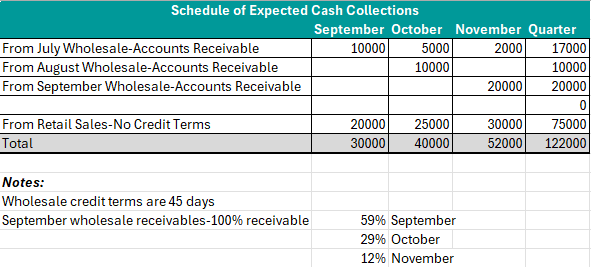
    The Missing Link: Schedule of Cash Collections

    What types of businesses need a schedule of cash collections?

    1. Businesses that extend credit terms to customers (ie: net 30)
    2. New businesses
    3. Businesses with low cash balances

    A schedule of cash collections predicts when budgeted sales will ACTUALLY be received into a bank account so they can be entered into a cash flow forecast. This schedule improves:

    1. Accuracy of cash flow forecasts.
    2. Forces you to examine why you think collections will occur at certain time.
    3. Brings to your attention types of sales (ie: wholesale vs direct to consumer) that may not be benefiting your company.

    SAVE ON SUBSCRIPTIONS

    Most small businesses pay too much money for too many online app subscriptions.

    Try following these three steps BEFORE your business subscribes to another app:

    1. Know Your Own Data:
      • What is your inventory method
      • What is your transaction volume
      • What types of sales taxes do you collect
    2. Investigate Current Apps for Unused Features
      • Explore features in your current apps-most apps are underused
      • Is there an add- on to a current app that is cheaper than purchasing a new app
    3. Subscribe for Growth
      • List any changes to business activities on the horizon such as sales to a new geographic area, hiring of new employees
      • Ensure new subscriptions meet needs related to these changes

    5 WAYS TO AVOID A CASH CRUNCH!

    PLAN CASH FLOWS

    Strategically time payments to vendors (instead of paying invoices when you receive them) so that you can:

    1. Take advantage of any available trade discounts and save money.
    2.  Avoid having to dip into a line of credit and then having to pay the related interest on the outstanding balance.

    SCREEN YOUR CUSTOMERS

    BEFORE you offer credit to customers:

    1. Ask for trade references to prove they pay their bills on time.
    2. Request a deposit from new/risky customers.
    3. Take note of your customer’s reputation in your industry.

    OFFER TRADE DISCOUNTS

    1. Customers are likely to pay in a timely manner if you offer trade discounts.  
    2. Review what types of trade discounts are common in your industry and your size of business.

    INVOICE IMMEDIATELY

    Prompt invoicing improves:

    1. Accuracy of invoice (you won’t forget details about work performed).
    2. Probability and timeliness of receiving payment.
    3. Demonstrates you run a functional, efficient business and improves your reputation for clear communication.

    CAPTURE YOUR ACTUAL PRODUCT MARGIN

    Include other direct costs in your gross margin calculation (in addition to cost of goods sold) so that you do not underprice your products and services.

    Expenses that may be a direct costs for your business and affect your gross margin:

    1.  Freight out (shipping products to customers).
    2.  Direct labour.
    3. Packaging and labelling.

    Cash balances do not take care of themselves. Try to take at least a few minutes to determine if there are any small changes you can make to your operations that may add up to significant improvements in your cash flows and start there.

    Sync Your POS and Accounting Software

    It used to be a pretty big deal to sync a point of sale system with an accounting platform but if you adhere to some basic rules, it can be fairly straightforward.  There are several benefits realized when you send information automatically between your POS and accounting systems:

    1. Reduce the chance of transcription errors- Remember that number 6 you entered that should have been a 9? Those errors are much less likely to occur when using automatic data transfer.
    2. Reduce data omissions-Did you forget to enter that last transaction yesterday?! Again, data omissions are greatly reduced through the syncing process.
    3. Change the focus of accounting labour- You can now shift the focus from manual data entry to analyzing performance or improving workflows.

    3 Tips to Ensure a Smooth Integration

    The most important thing to remember is to use all the safety checks available and run some tests!

    1. Be very comfortable with the workflow and map out what/how information will flow between the POS and your accounting software. Call POS support if you don’t understand. They are there to support the process.
    2. Double check your account mapping.
    3. Run a TEST!

    ONLINE SALES? DON’T FORGET SALES TAX!

    Thinking of opening an online shop in 2024? Don’t forget sales tax! Selling to customers located in different Canadian jurisdictions (provinces and territories), may require that you register for and/or collect and remit a regional sales tax (a separate process from GST registration).  British Columbia, Manitoba, Quebec, and Saskatchewan all maintain their own sales tax regimes.

    For this reason, and also for financial decision making purposes, it is important to track sales to different jurisdictions and the online sales platform that you select will play a role in how you accomplish this tracking. Some platforms will assist you in tracking and calculating the applicable sales tax, others will even integrate with a third party service that files and remits the calculated taxes on your behalf.

    There are benefits and drawbacks to the different levels of service, but the key is that you should be informed about sales tax thresholds and requirements before you begin selling into a new jurisdiction and also be prepared for the investment in admin time if you a required to register in multiple regions. In other words, think ahead!

    Check out an example of a quick reference page from Shopify below and contact your CPA if you have any questions.

    https://help.shopify.com/en/manual/taxes/canada/canada-tax-reference

    SHIFT TO VALUE FIRST PRICING

    Are you still thinking about ways to “add” value to the products and services to offer your clients and customers? When you are on the buying side, don’t you want value from the start, not as an afterthought or a bonus?

    What Does “Value First” Look Like from a Business Owner’s Perspective?

    Educate and Inform

    Sometimes providing Value First can be accomplished without changing your product or service at all. One of the simplest ways to achieve this is to remind, or educate your client about why you are working together and use your imagination to show them all the ways they can use their purchase to increase their own wellbeing or wealth now, or in the future. Loyal customers don’t just receive a product, they understand how the product improves their life. For example, instead of just preparing a client’s year end statements, we always take the time to teach them how those statements can help them secure new capital, improve their trade discount rates with suppliers, or take advantage of personal tax planning opportunities. We already have the information, we just choose to take the time to share it. 

    Get to Know Your Customer

    If you understand your customer, you can make small changes that effectively tailor your offering to fit their needs. For example, suggest a work timeline that acknowledges their busy season or clean their widget after you repair it if they will appreciate it.

    Give Information Freely

    Folks want help solving their problems. Give them the tools! You don’t need to give them all the tools, but you can certainly provide them with small tips or templates that transform their day in a tiny but impactful way. They won’t forget your generosity when it comes time to pay for assistance with larger challenges.

    Show your customer your energy and commitment to excellence. This builds trust and value based relationships that are priceless, not based on nickels and dimes.

    Out of Pocket Expenses

    Do your clients reimburse you for expenses you incur to provide a service (such as air travel, car rentals, specific office supplies)? The Canada Revenue Agency recognizes these as “out of pocket expenses”. While the amount of the reimbursement is left to be determined by the customer and the seller, there are rules around any associated sales tax.

    There are 2 factors that determine if the supplier (if they are a GST registrant and NOT acting as the client’s “agent”) should charge the sales tax on the pre-tax amount of the expense: Who receives the expense and the “place of supply rules”.

    Generally, if a supplier passes on the cost of an out-of-pocket expense incurred to create a taxable supply (service) to a customer, they will pass on the pre-GST/HST cost (this may include unrecoverable taxes such as provincial sales tax) of that supply and collect sales tax on that amount (they will not include the original GST/HST paid). They can then usually claim the GST/HST paid as an input tax credit against the GST charged and collected.  As usual, there are exceptions, so some preliminary reading is essential.  Happy Accounting!

    The CRA has a few detailed resources with easy to follow examples.

    https://www.canada.ca/en/revenue-agency/services/forms-publications/publications/gi-197/out-of-pocket-expenses.html

    3 Reasons Why Your Business Needs Social Purpose

    3 Reasons Why Your Business Needs Social Purpose

    What is Social Purpose?

    Social purpose has been described as an “enduring reason for being” that contributes to creating a better world. It has also been defined as “an engine for good” and “creating societal benefits by conducting business”.

    1. Motivation and Satisfaction

    No one will deny that earning money is both necessary and motivating. But it may not be motivating all the time. Social purpose can be that deep well of energy that gets you out of bed and helps you to shift focus away from your own troubles to positive participation in a broader community of problem solvers.

    • Competitive Advantage

    Social purpose links you to your customers, employees, and colleagues in a profound way. It can build an enduring basis for cooperation, collaboration, and loyalty. Translated into real world benefits, social purpose can help your business attract talented employees, build a loyal client base, and build unique supply chains.  

    • Peace, Harmony, and All That

    Some challenges can’t be solved individually. Some challenges aren’t being solved by governments. Some challenges won’t be solved through charity. Some challenges will be solved through businesses that leverage their daily activities to do good when they sell goods and services (even charities distribute swag or a tax receipt in exchange for donations creating an exchange of energies).

    Want to read more about Social Purpose? Check out these resources:

    Home Page

    https://hbr.org/2017/09/competing-on-social-purpose

    https://www.blackrock.com/corporate/investor-relations/larry-fink-ceo-letter